I love the touching scene in today’s reading when Israel at last is reunited with his son.
Israel said to Joseph, ‘Now I can die, now that I have seen you again, and seen you alive.
(Genesis 46:1-7,28-30)

I love the touching scene in today’s reading when Israel at last is reunited with his son.
Israel said to Joseph, ‘Now I can die, now that I have seen you again, and seen you alive.
(Genesis 46:1-7,28-30)

It was my son’s last day at his school. And we had Benediction in the Little Oratory. The service in Latin is so short, so beautiful, that it is intensely emotional. I left the school forty-eight years ago and now my son has left. I will go back. There will be other boys in their light blue jackets, but no son. Time passes. That is the only inevitability and if we cannot rejoice in it we can accept it, with, with not, a little tear two.
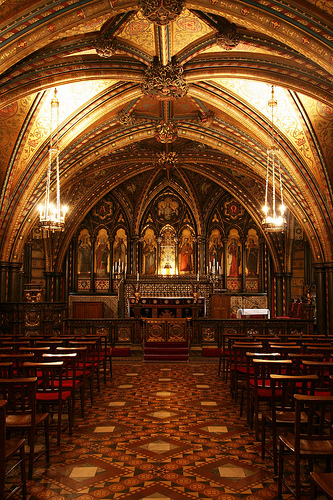
After Mass in the crypt chapel of the House of Commons, I sat alone. Above the chapel is St Stephen’s Hall, the site of the old House of Commons. As I sat alone in this ancient medieval crypt chapel I could hear the rumble of feet above me, heading about their business through the Hall. Somehow the business of the noise above me and the emptiness of the silence of the chapel summons up the two words of spirit and reality. One so much more sought after than the other.
Jacob’s adventures continue but at the end of today’s Mass in the Cathedral, the choir sang Jesu, Joy of Man’s Desiring by Bach. It was so beautiful that tears rolled down my cheeks.

I love today’s reading from Genesis. It is of Jacob’s ladder.
He had a dream: a ladder was there, standing on the ground with its top reaching to Heaven and there were angels of God going up it and coming down and the Lord was there standing over him, saying ‘I am the Lord the God of Abraham your father and the God of Isaac. I will give to you and your descendants the land on which you are lying. (Genesis 28:10-22)
I don’t know why I love it so much. It’s just a wonderful poetic image of angels climbing the ladder.

In another year, this is the feast day of Thomas. Doubting Thomas the Apostle I feel closest to. I dedicate this week to him.

I went to Mass at Westminster Cathedral and stumbled by chance across a two-hour ordination Mass. Expecting to be in and out in half an hour, I was a bit miffed. I had never been to one before. It is quite awe-inspiring seeing four young men sacrificing everything. I just know I could never do it but when they announced the places these four young men were saying their first masses the following day, I just knew that on Sunday I would not be able to match their joy.

Again a day juggling things, but I noticed that I was quite happy to dish Mass when everything else was in. Perhaps the dream was already fading.

It was my son’s school’s sports day and I had been asked specifically to speak in a debate that day. What to put first? I just did both: staying til the end of the sports day then before the prize-giving rushing like a mad thing by car and tube to arrive breathless ten minutes into the debate. I was forgiven.
It was the last Mass at my son’s school. I was asked at the same time to call on a cabinet minister. My wife knows me too well. She said that I would not want to miss the Mass, and I didn’t.
The dream was even more horrible than the previous day’s! I returned to Parliament and there outside was a very, very senior MP of independent mind, never been a minister, actually hanging. I was horrified. I ran in asking any colleague I met why this dreadful thing had happened. No one seemed to care. Indeed everyone was rather flippant. What was his crime, I asked. He spoke his mind. He has to be got rid of! Perhaps the dream was telling me that I should be more careful in the future.
I had a dream. I had arrived for Mass at the Brompton Oratory. It was obviously going to be a joyous occasion, high mass with all the works, and I was settling in to enjoy myself.
I then noticed that in a side chapel a famous politician, a very famous one that was about to give a talk on politics today.
Foolishly I was tempted. Perhaps there was something I hoped to gain by being ‘seen’. It was a big mistake. The talk was of course vacuous in political content but more important, when I asked questions no straight answer was given. I wished profoundly that I was still in the mass. Perhaps the dream was trying to tell me something!

Some children were taking First Communion in our local church. It’s so sad that one can never repeat except fleetingly this onrush of first faith at the age of seven. Everything is magical, new, and utterly believable. Doubt is driven to the future. Now we can only share the pleasure vicariously by watching the children take their Communion.

The interchange between Sarah and Abraham comes to us as legend but is curiously human and realistic. The poetry speaks to us as if it really happened.

And now, at ninety-nine, Abraham is promised another son, Isaac, and the covenant will be with him. Did he ever doubt?
Abram at last gets a son – Ishmael – at the age of eighty-six! He never seems to have lost faith that one would arrive.
Today Abraham falls into a deep sleep but in his sleep, I suppose in a dream, he received his covenant. It’s strange how important dreams are.
Today I could not sleep and started saying the Rosary to send me to sleep. I kept waking, remembering a dream for a few instants, and then going to sleep again.
Abraham obviously had a special relationship with God and was it seems in regular communication with him. Why have we lost it I wonder and what has happened to the promises to us that he received so readily. Perhaps we have become too sophisticated, too close to reality, and Abraham lived in a simpler, rawer age.
“All the land within sight I will give to you and your descendants forever.”

This week’s stories from Genesis follow the adventures of Abraham. The first question is what tremendous faith he had to wander off in the first place. Would we have done it? I think not.
The Lord said to Abraham, ‘leave your country, your family and your father’s house’ and he did!
Dear Gabriel,
People often wonder at the complexity of the Trinity and when priests give homilies on the subject they say that it is one of the most difficult Sundays to preach on, but for me the logic is not difficult. A God that exists obviously can’t be like us. He can’t just have a single intelligence but must have many parts. Thus to me a concept like the Trinity makes sense. God then is part human incarnation, part spirit, and part resident of heaven.

At the end of this week St Paul writes that “I shall be happy to make my weakness my special boast.”
I suppose that’s all we can do and we should be content with that.
“So many others have been boasting of their worldly achievements,” writes St Paul today. I suspect that a God that exists cannot see or is not interested in the outward body. To him the most outwardly disabled person, the oldest and sickest, has as shining an inner soul as the fittest, youngest and most beautiful.
Dear Gabriel,
Like St Paul today I “only wish you were able to tolerate a little foolishness from me”.
Maybe in your eyes this advice is foolish, but I can only give what I know.

Dear Gabriel,
This is the most difficult advice that St Paul gives this week.
“Thin sowing means thin reaping; the more you sow the more you reap.”
But it’s so tempting just to sit in a quiet place and read a novel, and is one then not sowing in one’s own mind; and that’s one of the most important places to be.
Dear Gabriel,
The obverse of yesterday’s reading is today’s.
St Paul refers to the “constant cheerfulness of the brothers” despite great trials. I suppose that’s what CS Lewis meant by being surprised by joy.