Up to Christmas

SUNDAY

That reading again: “This is how Jesus Christ came to be born.” The patter of words carries on.

I went for a walk around Chiswick House. The Ionic temple sat reflected in its pool of light, calm and still. The paths laid out by Lord Burlington radiate out in perfect symmetry.

MONDAY

Zechariah’s power of speech returns. And, of course, his faith.

Third Week of Advent

THIRD SUNDAY OF ADVENT

I remembered a story from the sermon the week before, prompted by what I heard today which I could not remember.

A blind man had put out a sign as he begged, sitting on the street: “Blind. Please give generously.” Very occasional coins tinkled into his hat. He sensed a person stopping. He could only feel the shoes. The lady wished him well and departed. Then suddenly coins started pouring into his hat. Later she returned and he touched her familiar shoes. Why had things changed after she left? “I turned your sign around,” she said, “to read ‘It’s a beautiful day and I can’t see it.’”

Words matter.

Of course the new sign excited pity. Words matter. It is worth writing them down. But there’s a deeper meaning. How often do we forget that it’s a beautiful day; or a beautiful world? And who, what created it?

Last week I walked to the Thames. There was heavy fog, so heavy that I could not see across to the other side. I might have been on the edge of the ocean. The sight of the Thames was extraordinarily beautiful.

MONDAY

We went to a friend’s funeral, the same church, the parish church in Gainsborough, for another friend a few weeks ago. Here in a small town you are remembered, surrounded by friends and family, the church packed. In a big city, you are lost.

TUESDAY

The genealogy of Jesus Christ was read out at Mass. You can always hear people inwardly moaning. It is very long, but calming and beautiful in its way. But I never quite see its point. It ends with Joseph, but surely he wasn’t Jesus’ father.

WEDNESDAY

Once again the reading from Matthew 1:18-24: “This is how Jesus Christ came to be born: …”

Heard again and again at carol services and masses, like a patter of rain, the usual image seeps into the brain. We were told today that the translation of “Joseph, being a man of honour” is a rubbish translation. It should read “being a just man”. What if he had said no? No marriage, Mary stoned to death, Jesus killed in the womb, a silent God on high, no message, no redemption. His son still dying for us but we know nothing of it.

THURSDAY

Poor Zechariah. When Gabriel gave him the good news about his wife, he didn’t believe it. She was too old. As a punishment, he was struck blind. How many times should I have been struck blind for not believing.

We all went to Buckingham Palace for the investiture. A slightly bizarre occasion. The Prince of Wales expressed the hope to me that I would carry on. I almost said “Just like you, I intend to” but didn’t. Perhaps this would be lese majeste!

FRIDAY

I was in Tate Britain looking at a painting by Reginald Frampton, Brittany 1914. The figures seem curiously detached from the reality about to hit them. Did Mary truly understand the cataclysm about to hit her?

SATURDAY

The sun streams through the narrow windows behind the altar in the Cathedral blinding me; only vague shapes emerge on the altar. Like Zechariah, my lack of faith dulls my senses.

Second Week of Advent

SECOND SUNDAY OF ADVENT

We went back to the play. As my son was singing “Bring him home” for a moment, in his look or in his voice or a transitory note, I saw and heard my dead brother. What an extraordinary sensation. Of course it is not unlikely. The genes after all are the same but I had never noticed it before. It was only the emotions of the song that caused the recognition. The song is a prayer for protection of a living person. My fleeting recognition was of a dead person, once so familiar now gone. Who are we? Are we a single entity or part of the part of something else?

MONDAY

I went to the House for tributes to Nelson Mandela. The point is obvious. Like many great men he will be judged by magnanimity in victory, or rather he is one of the few people who fulfilled it.

TUESDAY

Although the poetry comes round every year, it never ceases to astound. Has anyone ever written anything finer than Isaiah?

“Let every valley be filled in, every mountain and hill laid low… then the glory of the Lord shall be revealed.”

WEDNESDAY

I did a reading in the Order of Malta carol service. Some years I have done, attended five of these. They can be a bit formulaic. This one is made not so much by the beauty of the church or the candlelight but by the Benediction of the Blessed Sacrament and the power of John’s verse, healthily spoken out. For a moment, its power overwhelmed me.

THURSDAY

To another carol service, at Downside Abbey. The king of all carol services. It is the power of the Schola of course but also the fact that it is bookended by plainchant and focused at its centre on the Benediction. Too many carol services are just jaunty tunes interspersed by fairy tales… in the view of many who go to them. How sad.

FRIDAY

Advent to me is about a light. It flickers at first, then grows as the candles do. The response to the psalm then has particular power:

“Anyone who follows you, Lord, will have the light of life.” (Psalm 1:1-4)

These words kept rolling over in my mind. What light, what life, whose, where, how? Is this a general statement or addressed to me? Do I believe it? Yes, listening to it during the Mass I did, then forgot it for the rest of the day.

SATURDAY

As I was walking down off the Wolds at around four o’clock, it was nearly dark. The features of the landscape were fading into each other – trees, bushes, grass were all fading into each other. Each shape was inchoate. There were no longer bright greens, blues, yellows; the last colour of late autumn, only a delightful greyness, some dark some lighter, fading into each other.

Belief for the Unbeliever

FIRST SUNDAY IN ADVENT

Today is the start of the Church’s year. Perhaps it’s a good opportunity to start too a guest in faith. Why do I struggle with belief? How can I believe? Some will or may come to it suddenly or unexpectedly.

But for me and I suspect for most of us it is a daily struggle. So I think it’s worth looking at it – the question of God’s existence or otherwise – not as a great mountain but as a daily step.

In reading every day and trying to go to Mass perhaps I can make a little progress and maybe others too may find this approach useful.

Today I went to a family First Communion in St Nicholas Church on the river at Chiswick. A beautiful Anglican service, complete with Sanctus and Agnus Dei in Latin. The church, this ancient church seemed content with the service.

Later I walked to Barnes Bridge. Here I was brought up, here I used to walk nearly fifty years ago. I wondered if I walked now to the Crescent, if I rang the bell, would my mother open it? Would I find my father inside on the green chair reading his newspaper, the chair on which he died. Where are they now? But in my mind’s eye, they still were there. So faith is in the mind.

Later, in the Cathedral, I read today’s words in the Gospel:

“Stay awake! You do not know the hour.”

No we do not, and most times we plod on, forgetful. But just once a day cannot we think internally?

MONDAY

We went along to Lambeth Palace for an Advent Service with the Archbishop of Canterbury. This is always a most beautiful service. In these ancient medieval melodies one can lose oneself. For a moment one can feel real joy. Here too in today’s Gospel one can walk with the Centurion.

“Sir, I am not worthy to have you under my roof.”

A good reading for the first weekday in Advent.

TUESDAY

We had a debate on the persecution of Christians in the twenty-first century. There was the usual relativism. We were told that Christians are persecuted in 105 countries and Moslems in 101. Maybe all persecution is wrong. But the overwhelming denial of human rights and downright persecution in the world is against Christians.

I referred to the French film “Of Gods and Men” which I had seen on Sunday night. There is a lovely passage when Father Christian confronts his tormentors with the passage in the Koran exhorting peace between faiths. If you persevere, if you concentrate sometimes as in a moment at the Advent service you can feel joy.

“Filled with the joy of the Holy Spirit.” (Luke 10:21-29)

WEDNESDAY

I led a debate on funding of dermatology. One of the best moments of the week, indeed of the month, was when walking out of the debate. A lady who suffered obviously from a skin condition thanked us.

“He sat there, and large crowds came to him, bringing the lame, the crippled, the blind, the dumb, and many others.” (Matthew 15:29-37)

THURSDAY

As I emerged from a meeting with some important people, I should perhaps have remembered today’s psalm (117):

“It is better to take refuge in the Lord, than to trust in princes.”

FRIDAY

I was talking to someone at a surgery who clearly has a lot of problems and is almost defeated by life and ill health.

What a pity one cannot do this:

“Then he touched their eyes, saying ‘Your faith deserves it, so let this be done for you.’ And their sight returned.” (Matthew 9:27-31)

SATURDAY

We went to a performance of Les Miserables at my son’s school. He told us he was in the chorus. In fact, he was playing Jean Valjean. Les Miserables in particular the song “Who Am I?” is I think a profoundly Christian play. The words express the Christian dilemma. At one level, they pose the question: should one lie to survive? “If I remain silent, I am damned. If I speak up I am condemned.”

But I think there is a deeper meaning. Who am I? Do I have a separate or meaningful existence? Where does my consciousness of self come from? Is it a mechanical, chemical, or spiritual consciousness? Is it material, fleeting? Should it owe allegiance to this real world or another, unseen, which may be illusory?

Christ the King

SUNDAY – Feast of Christ the King

Always a difficult one, because of the last lines of the Gospel: “in so far as you neglected to do this to one of the least of these, you neglected to do it to me.” (Matthew 25)

MONDAY

Professor Alister McGrath came to speak to us about the life of C.S. Lewis on the fiftieth anniversary of his death (23 Nov 63). The point I made and believe is that C.S. Lewis is timeless because he struggled with belief and because he addresses as a story the question of the existence of God and the rightness of Christianity. Church leaders need to stop talking about structures and about spirituality.

TUESDAY

When I walked into the Cathedral the light was streaming through the southern windows blinding me. Appropriate for the first reading: “a statue of exceeding brightness stood before you.” (Daniel 2:31)

WEDNESDAY

When I heard the words from Daniel – “Mene, men, tekel upharsin” – I thought this would be our fate if God forbid Scotland breaks away. “Parsin” Your kingdom has been divided.

THURSDAY

I was sent by my daughter a quote from Meister Eckhardt that seemed very appropriate. It goes something like this:

“If you only say one prayer in your whole life and that is ‘thank you’, that is enough.”

A powerful thought.

FRIDAY

I was sitting on the train thinking once again on Meister Eckhardt’s advice. There is so much to give thanks for: children, family, marriage, health, a job. Why mope and be morose – an inevitable part of human nature I suppose.

SATURDAY

Daniel this week in his canticles reflects Meister Eckhardt’s advice.

The autumn colours in Lincolnshire have faded dramatically in less than one week.

O sky, and moss, and autumn trees. Bless the Lord.

Back in England

MONDAY

When we got back to England there was a programme on about English Cathedrals. How they had to move with the times, etc. I thought how empty they were, a few worshippers certainly but mainly museum pieces. Then I thought back to the day before, to the great Sikh temple in Delhi, the thousands of pilgrims and worshippers moving forward slowly. Has the Sikh religion felt it necessary to “move with the times”.

TUESDAY

The readings this week are from the Book of Macabees. How Eleazar and others suffered torment and death rather than compromise their religion. I wouldn’t hesitate to compromise. Would they be now more than half of one quarter of one per cent in our society who wouldn’t compromise? Yet however many resisted in the tumult of the sixteenth century.

I often wonder what would Zaccheus have done if Jesus hadn’t looked up and called him.

WEDNESDAY

I have never understood “To everyone who has will be given more; but from the man who has not, even what he has will be taken away.” (Luke 19:11-28)

It all seems rather harsh.

THURSDAY

When the Gospel was being read about the prophesy of the Fall of Jerusaelm my mind wandered. Started thinking of my visits there, fascinating and moving yes but the centre of the universe? Where the creator of all these billions of stars manifested himself, on which I wondered. Wonder in all senses of the word.

But it took Lord Brennan at the AGM of the Catholic Union to remind me of the true importance of the last phrase which I had missed.

“… and all because you ddi not recognise your opportunity when God offered it.” (Luke 19:41)

What opportunities are we missing.

FRIDAY

The day of the Referendum Bill in Parliament. I made several interventions about our beliefs. That we want once again to control our own borders, our own fishing grounds, our own courts, and regulation on our own businesses.

I cannot match the eloquence of today’s reading from Macabees; I had run off early to Mass and heard it: “Judas and his brothers said: Now that our enemies have been defeated, let us go up to purify the sanctuary and dedicate it. So they marshalled the whole army and went up to Mount Zion.”

SATURDAY

Sometimes we feel we have failed in our campaigns and we are like King Antiochus who “threw himself on his bed and fell into lethargy from acute disappointment, because things had not turned out for him as he had planned. And there he remained for many days, subject to deep and recurrent fits of melancholy.”

But at least we haven’t done what he did: “But now I remember the wrong I did in Jerusalem.” (Macabees 6:1-13)

Travels in India

MONDAY

As I write this I am listening on the verandah to night prayers starting over Delhi’s traffic noise. Today we have walked around the Lodi Gardens. Of course I was tired but at the tomb of Mohammed Singh, the Mogul Emperor, I felt a great depression. So much power and beauty: now crumbling stone. The crows wheeling slowly overhead, the November sun orange in its intensely setting, always unlike an English park. Some movement.

TUESDAY

I stood on the edge of Jama Masjid, the Great Mosque of Delhi’s Old City. India in all its teeming life was before me. At times, like there, the impossibility of redemption seems close. Say there are five billion humans and five billion planets with intelligent life in the universe. How could God – any god – know every hair of every head? But God surely is not just us, it is much more and much less. It is the whole of us but something different. I dreamt that God was a vast unity, a kind of brain and we were all inside. God was not looking down on us, a separate distant intelligence but was looking at us with an inward eye. It is strange how little organised religions talk of the nature of God. We waste so much time on futile arguments about arcane liturgy and rules when no one actually knows or could know the will or wills of God.

WEDNESDAY

In the vast modern concourse of Delhi’s domestic airport, I paused at the bookshop. The usual John Grishams, Jeffrey Archers, etc., and the Bhagavad Gita. I bought it. I was struck by Gandhi’s remarks: “The last nineteen stanzas of Chapter 2 have ever remained engraved in my heart.”

They are indeed unexpressingly moving.

“That man alone is wise who keeps mastery of himself! If one Ponders on objects of the sense, there springs Attraction, from attraction grows desire, Desire flames to fierce passion, passion breeds Recklessness; then the memory – all betrayed Lets noble purpose go, and saps the mind, Till purpose, mind, and man are all undone. But, if one deals with objects of the sense Not loving and not hating, making them Serve his free soul, which rests serenely lord, Lo, such a man comes to tranquillity.”

Gandhi says these verses contain the essence of Dharma.

THURSDAY

Meherangarh Fort

The great fort of Jodhpur rises up from the city of one million souls. As I stood on its ramparts I looked down upon the blue-glazed, flat-roofed houses.

What is the meaning of Gandhi’s “non-attachment”? I don’t believe that non-attachment is right for most people. Can one be non-attached to the necessity of food? Can, should, the soul be non-attached to the needs of the self: work, love, health, life, home.

I prefer the way of what I call Right Attachment. A median way of attaching worth but not undue care or worry to most things.

“Most things don’t matter and hardly anything matters at all.”

FRIDAY

What is the nature of the Divine? In Chapter 11 of the Bagavadgita

“So did Pandu’s Son behold All this universe enfold All its huge diversity Into one great shape, and be Visible, and viewed, and blended In one Body – subtle, splendid, Nameless – th’ All-comprehending God of Gods, The never-Ending Deity!”

We walked down the dusty lane from the Fort of Chandelao to a lake – past veiled, sari-ed women, brightly coloured, carrying everything on their heads. The November sun hot, sacred cows, wandering barefoot children playing, goats standing, the dry, flat plains all about.

For Indians, the very earth is sacred. Here in the numberless villages of India, time is slower, lengthened.

SATURDAY

The Gandhi museum is strangely moving. His sayings are displayed. The simplicity of the room in which he spent the last eighteen months of his life. Everywhere his life confronts our own. Tears rolled down my cheek. “I want, if I don’t give you a shock, to realise identity with even the crawling things on earth, because we claim descent from the same God, and that being so, all life in whatever form it appears must be essentially one.”

Finally one follows in his footsteps across the manicured lawn to the place of his martyrdom. I went on to the Indira Gandhi museum, where she also lived and was assassinated. Now the prevalence of death and of her son Rahul was too depressing. Why this violence and hate?

SUNDAY

A contrast. First Mass in the Papal Nunciature, a grand neo-classical building with green lawns roundabout and likenesses of recent popes and Mother Theresa, then on to the Gurudwara, the main Sikh temple. It was a feast day. We formed an intense stream of brightly coloured pilgrims moving slowly into the Temple and around the lake. I bought two contrasting books: the last stand of the 31st British Army Sikh Regiment in the Afghan Wars of the 1890s. All 21 soldiers in a signalling fort were killed by Pathan insurgents. And next a meditation including this from Gurbani, a Sikh guru:

“Walking in the ways of life, moment to moment, live by Godly qualities.”

Everywhere we were treated with great courtesy. Sikhism seems a most attractive religion.

Thirty-First Week in Ordinary Time

MONDAY

It suddenly occurred to me that we spend too much time thinking on what we do not have, what we have missed out on, rather than what we are, what we have.

TUESDAY

The Gospel reading today is about people giving excuses for not coming to a wedding. How many times do we give a pathetic excuse for not doing something.

WEDNESDAY

So I was tempted to give an excuse not to spend a tiring evening speaking at Oxford University on faith and politics and missing an important meeting in London but thought I better not. In the end, only four students turned up.

Really, faith in politics, certainly Christian faith, is dying. To our great impoverishment. Yes, us four had a good conversation. There is always a lot of good talk about lost causes in Oxford.

I walked past Latimer and Radley’s memorial. What would they have preferred: a Catholic or an indifferent England?

THURSDAY

About thirty parliamentarians who had served in the TA or Regulars went to the Guards Chapel for a Remembrance Service. It is a moving place. When it was bombed in 1944 and over a hundred people killed, the candles kept burning on the altar.

FRIDAY

The Gospel reading was about the dishonest servant. Is the true meaning that one has in any way to prepare for and insure against the next life?

SATURDAY

At our oblates’ talk in the Abbey, Father Alexander was explaining the Beatitudes.

I have always thought the consolation for not having power is that it gave one the opportunity to speak one’s mind and be honest. But the Beatitudes also make plain that it is the lack of something, certainly riches, even life, that can be the great opportunity or blessing.

SUNDAY – THIRTY-SECOND WEEK

Market Rasen was packed for Remembrance Sunday. In the Anglican Church I cried again at the story told of the execution of a teenager at Auschwitz. Someone asks “Where is God in all this?” The neighbour answers “God is there in that noose.”

Thirtieth Week

SUNDAY

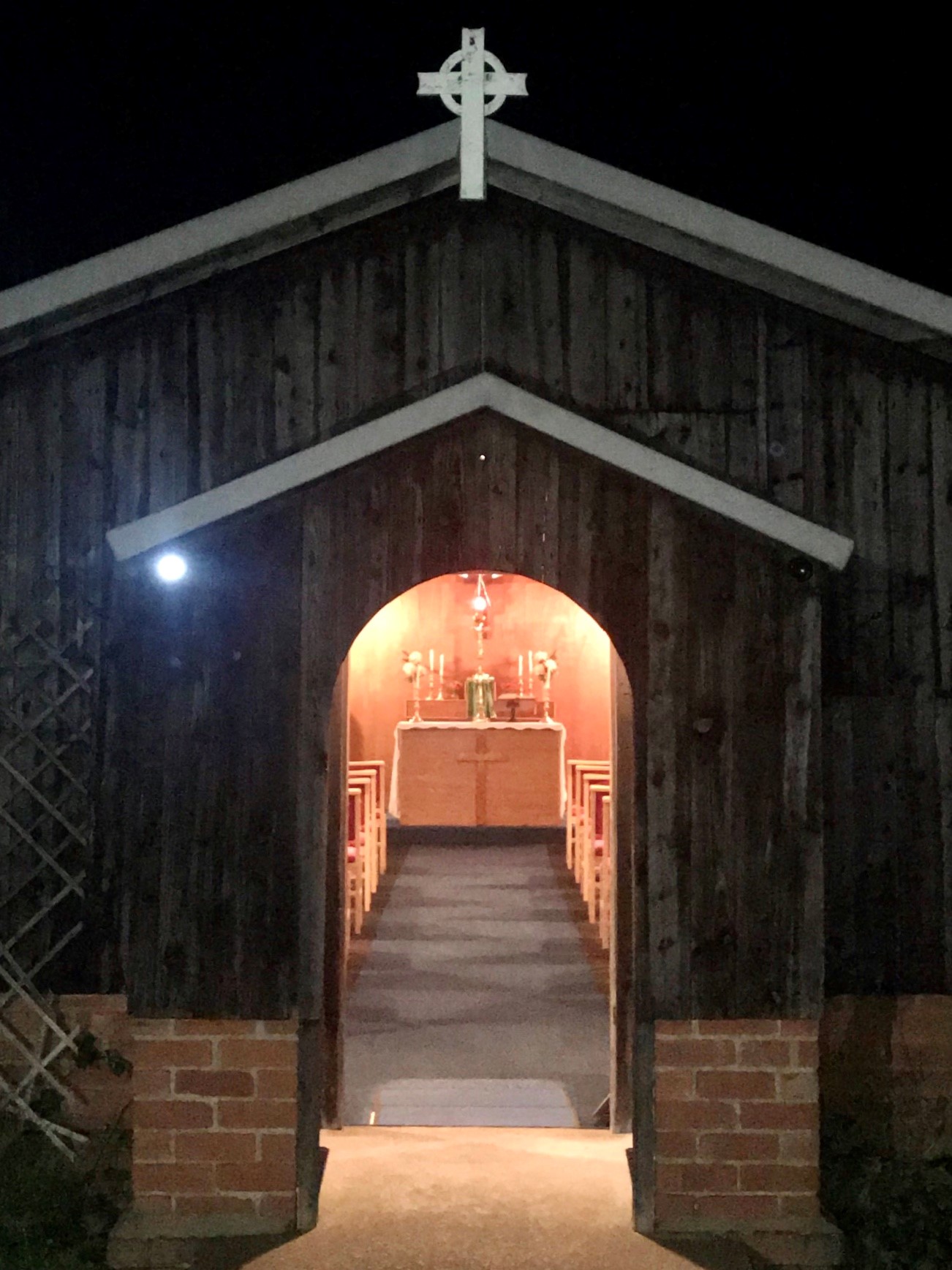
By contrast I went to the little chapel next to us to hear a said not sung Mass, entirely in English. I am happy with that too. I concentrated on the words of the Gospel and the words of the tax collector as opposed to the Pharisee who prays to himself, “Have mercy on me a sinner.”

MONDAY

We attend the funeral of Cllr Chris Underwood Frost in Gainsborough Parish Church. It is a sad thing that when we reach a full span of 80 years or more there are few to come to our funeral. It is no comfort though when we die young in our prime, in our 50s. The church is full of friends and admirers. But do we only live on in the minds of others? No, when we die old, the panoply of friends and relations, mother, father, or sister, are still there but in the Heavenly Host.

TUESDAY

I was talking to someone about the plight of Christians in the Middle East. They want to set up a charity which will not focus on the political situation but on the cultural heritage of Christians. I am sure this is right. We must not lose this rich stream of continuous history particularly the villages, some of which I visited in Northern Iraq which still use Aramaic. My host recited the first words of the Beatitudes in Aramaic: what a glorious sound.

WEDNESDAY

The readings today are all about the power of prayer. “The spirit comes to help us in our weakness.” (Romans 8:26-30).

We can go through the motions of Mass or the Rosary or Matins or whatever but unless we ask we are nothing.

THURSDAY

I sat through four and a half hours of debate on HS2. Strange how those in favour and against the line dress up their arguments in a kind of religious fervour. Ultimately it is only a railway line which carries a few people fast to where, if they really thought about it, they probably don’t want to go.

FRIDAY – FEAST OF ALL SAINTS

I always love this image of a “huge number, impossible to count, of people from every nation, race, tribe, and language.” And “they shouted ‘Victory to our God’.”

I like the way also that most of them, the Saints, are completely unremembered to history.

SATURDAY – FEAST OF ALL SOULS

Now in our Lincolnshire garden we have the full glory of Autumn: browns, reds, golds, every shade of green, light, dark, a remarkable number of leaves stay still on the trees, gently swaying. It is warm enough to sit in the garden for a time and feel the soft Lincolnshire breeze. The glass is still a richly golden green colour, the remains of the stubbled field opposite still yellow, not a house or a car or any semblance of ugliness in sight. When the first car in an half-hour glides by, its wheel noise lost instantly in the leaves underfoot. It is so quiet. I can hear the blood pumping around my ears.

I run along the lane under the great yellowing beeches and enter our Norman church. I read Psalm 9. “Confiteor Deo tibi / I will speak of your marvels O Lord.”

Twenty-Ninth Week

MONDAY

If one can do no other than remember today’s Gospel, so many of life’s problems and successes would fall into place. “Fool, this very night the demand will be made for your soul.”

TUESDAY

We were in Rome with the All-Party Group on the Holy See. We called on Cardinal Turkson and asked him about Syria. Did the Pope’s day of prayer and fasting help to avoid a wider war? It certainly did no harm.

The first sight of St. Peter’s Square when you arrive is always awesome. It is just on such a large scale. Archbishop Muller had explained to us the difficult position of the Church on communion for divorcees. Ultimately though all the Church’s teaching has to be based on love and compassion.

WEDNESDAY

Along with 110,000 other people we went to a General Audience. I nominated two of our number to shake the Pope’s hand. We, meanwhile, want to see the equivalent of the Cabinet Secretary to find out about the reform of the Curia. The reality is much more prosaic than the media hype. It was strange to be standing alone in the Scala Regia alone with the Michaelangelo and Vasparis on the other side of the door to the Sistine Chapel.

The Foreign Minister equivalent whom we met at the end of a long day for him and us seemed only to really speak with life and cease choosing his words when falling about his working relationship with Francis who really is inspiring them all. I like him but I also liked Pope Benedict who despite his deep intellect had a twinkle in his eye.

THURSDAY

What a privilege to have our little Mass said for us in the Crypt of St Peter’s. Looking at the tomb of St Peter. The glass reflected an image of us superimposed on his tomb, an allegory of our pilgrimage toward him.

FRIDAY

We had a debate on multiculturalism in the Council of Europe. I alone attacked the concept. We should learn from the success of Jewish immigration into England. Jewish people took English names and fully integrated. There is no anti-semitisim and they often lead the way in industry, arts, and politics. If other immigrants ghettoise themselves in their own dress, homes, and aggressive practice they will not advance. So the liberal thinktanks and politicians who addressed us on the virtue of multiculturalism are actually the enemies of Muslim progress in the West.

SATURDAY

It was a Day with Mary in the Cathedral, which was packed. Yet the Administrator continued with the usual sung Latin Mass. This vast crowd who don’t or perhaps never are given an opportunity to hear a Mass in Latin seemed perfectly content and happy to take part. The truth is that the Novus Ordo Latin Mass is simple, clear, and easy to understand. When sung in Latin it is beautiful. Why did we ever get rid of it?

Twenty-Eighth Week

MONDAY

I had lunch with someone who intends to beat the world speed record for motoring round the world. I think his greater achievement was to sail an old yacht – Lively Lady – very slowly around the world. He told me it was really drifting round the world. What is wrong with drifting on ocean currents? It must be the most extraordinary physical and spiritual experience to be powered slowly at walking pace around the world by wind. What a test of patience and stolid endurance.

TUESDAY

I was speaking against visiting on all dogs the sins of the vicious ones. More regulation, more problems. Everyone remarks on the placid temperament of our William: he gives only calmness, loyalty, and love. How can he too not have a soul?

WEDNESDAY

The chapel at the House of Commons was crowded. Why do we concentrate on the irritating person in front rather than the mystery at the front of the church? Human nature or the devil? I doubt the existence of a malign and scheming devil. There is enough devilry already within human nature at every level to make the existence of a real devil unnecessary.

THURSDAY

We had a debate on Army Reserves. With the shortage of monastic vocations will we come to rely more and more on oblates that are part of a monastic community but do not make a vow of stability for life? I think that may be the way forward.

FRIDAY

We went to Jim Broadbent’s film, Le Weekend. He makes a long speech on the hopelessness of his life – forced early retirement, no money, wife going off.

Naturally no mention of a fall back on spirituality or religious life in any shape or form. Is this why society is so depressed?

SATURDAY

I was in the Abbey church at dusk after Vespers. The light was diffuse and subtle. I had one of those fleeting moments of a shift in consciousness of a complete belief and acceptance. Belief to me is not a settled absolute yes or no, it is an acquired and growing experience, an accumulation of small moments, each of them valuable in themselves.

SUNDAY

The Gospel reading today is focussed on the power of prayer. We were told rightly that there is no one good way of prayer. Going through the motions? Better to go through the motions than not try at all. Lectio Divina great, but if it doesn’t work, move on. “Pray as you can, not as you can’t.”

Reshuffle Day

Talking of jobs, its reshuffle day. More interesting the Gospel reading is that of Martha and Mary. The Marthas are the shufflers and the shuffled of life, perpetually moving, wanting more, wanting to be something else but are they ever happy? Today is the lawyer, a shuffler who asks how he can inherit eternal life.

Of course you have to love your neighbour as yourself, but, ah, how to do it? When in the quiet of the Abbey, I am happy, it is easy to do. It is always a trial travelling in the crowded train on the way back.

But you have to view everyone, even the meddler on the mobile phone as a friend and a neighbour, not as an irritant. Easy to contemplate in theory, impossible to do, but I can start to make the effort.

So today I was in a train, a mobile phone conversation started and went on and on. Did I love the mobile phone? No, I just moved a few places. During the journey I read Eckhart Tolle. It was alright but I got more out of staring out of the window and capturing a moment, a deep lake, a van parked alone in the field, a barn, a view of distant downs. But Tolle would probably accept that this experience of a moment is as important as any book.

Feast of St Bruno

We heard of his life. The most charming aspect is his constant having to flee from being given jobs. Not a problem I have ever suffered from, but happiness we know came to Bruno and to us not from being a bishop or its equivalent but in the silence of the moment, in quietness, and creeping then sudden calm acceptance and joy.

Exegesis

I was in the Abbey. We had a talk, a brilliant exegesis on the Gospel of St John. I had not realised that John mentions the Light of the World so many more times than the other evangelists. All this is very interesting but it was only later, alone in the darkened abbey in front of the raising of Lazarus that a sensation of acceptance came over me.

I read Thomas Merton in the evening. I love his simple style and description of his spiritual journey. Tonight I was reading of his discovery of the spiritual exercises.

St Francis of Assisi

The Mass is packed in the small chapel in the Cathedral. The priest asks us to, I think, “vivre un reve”, to live a dream, our dreams, in a dream! I am sure all due appropriate to St Francis.

Later on the boat, the sun sets in a glorious autumn brightness.

The whole sea is spottled golden. The sky, thin fillets of it were redder than I have ever seen before.

A Pilgrimage to St Odile

We went on a pilgrimage to the Monastery of St Odile in the Vosges – well a sort of pilgrimage, a friend said it was a beautiful place to visit and the photo of the buildings on a high rock looked nice. So we went. I expected another dead, half-ruined monastery.

Instead we found a vibrant pilgrim place. I realised that as soon as we arrived and saw the plaque of John Paul’s visit in 1988.

High on its celtic stones lies the Monastery of St Odile. Great boulders and huge views over the Plaine d’Alsace stretch out to infinity.

Bands of horizontal mist lie in every fold of every valley retreating into a grey insubstantial distance.

The basilica is open. We arrive and by chance a Mass starts. Here in this place we think of a celtic princess, blind from birth, rejected by her father, hidden, and somehow cured.

Down the hills is the “Source”. Here St Odile tapped the rock and cured a leper. Here we put the cooling water on our eyes and hope for her cure too.

We leave reluctantly, driving through the vineyard villages, picture postcard in their country Germanic beauty, vines even growing over the road: a great arcade.

But we remember St Odile on her high rock.

The Lord gave, the Lord has taken back

SUNDAY

I was in the Cathedral listening to today’s Gospel, the story of the rich man and Lazarus. Of course the demanding part of the story is that the rich man actually did nothing wrong. He did not abuse or maltreat the poor man. He just ignored him or perhaps was not even aware of him. We are told not to give money to beggars. They will spend it on drink. I was careful to give money to the next person begging!

MONDAY

Today’s reading is the familiar one from the book of Job.

What would be our reaction to these terrible disasters? Dumb shock, misery, and despair, I suspect; certainly not Job’s words.

“The Lord gave, the Lord has taken back. Blessed be the name of the Lord.”

This after he has heard the terrifying news of the loss of all his property and those dearest to him.

TUESDAY

St Therese of the Child Jesus

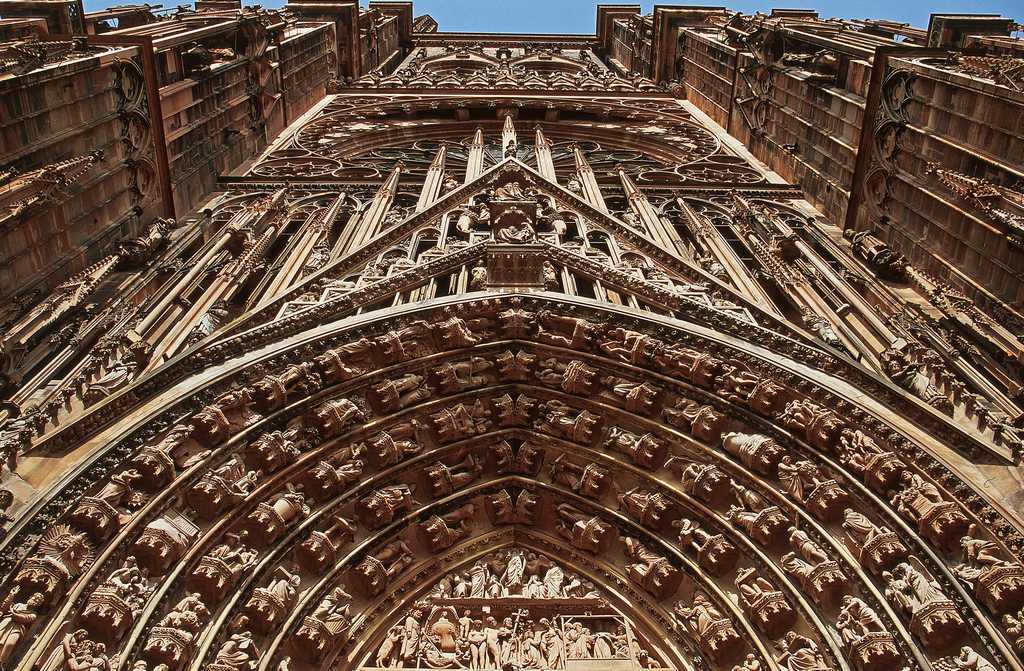
I was in Strasbourg Cathedral and as usual the priest gave a most beautiful mass and sermon.

Just six exercise books of notes was all Therese left at her death age 24 after a wholly uneventful life, but what glory followed and how simple is her concept of spirituality: a love of little things.

WEDNESDAY

I nearly couldn’t get up for the 7.30 Mass at the Nunciature but it is always worth going. Not least because the downstairs room is so small and intimate.

They are going to add a sixth panel to the saints of Europe in their small stained glass window in their basement chapel: dedicated to St John Paul II.

Twenty-Fifth Week in Ordinary Time

SUNDAY

Another long train journey, this time quieter, and then Mass in the Cathedral.

MONDAY

Feast of St Padre Pio

I went to Mass in the Abbey. What did Padre Pio have? He died a few days after the fiftieth anniversary of his stigmata. Were they real? Did he imagine them and they appeared? What sort of man was he?

It was a glorious September day and we walked to Pentire Point.

We saw what you rarely see in England: the sun at 7.18 dipped right into the sea, no haze. Before doing so the sea became a brilliant speckled gold.

TUESDAY

This was a glorious September day of mist and sun and cloud.

“Like flowing water is the heart of the King in the hand of the Lord. Who turns it where he pleases.”

The water surges indeed where it pleases, crowing out the rocks round Polzeath but in Daymer Bay it is quiet. So quiet the water creeps up to the hills almost by stealth. Walking back from Rock there was not a moment to lose. We hitch up trousers and wade round the rocks and into safety.

WEDNESDAY

A long walk from Padstow round the point to Trevone Head and back to Padstow. Some rain and the sea calm way below. The tide so low in Padstow Bay that one can see the water rippling over the “Doom Bar”, the sandbank that has wrecked so many sailing ships desperately seeking shelter in a storm.

The 25th September it is our 29th wedding anniversary, a shelter in a storm.

“Two things I beg of you. Do not grudge me them before I die. Keep falsehood and lies from me. Give me neither poverty nor riches.” (Proverbs)

THURSDAY

“Southward goes the wind, then turns to the north: it turns and turns again, back to its circling goes the wind.” (Ecclesiastes 1:2)

For a time upon the coastal path I was alone. No one visible as the path wound its way to the summit, below only the sea, the waves gentle swelling before a crashing view, the sun appearing and disappearing, the wind coming and turning.

FRIDAY

I was reading one of my son’s school books – a simple introduction to Christianity. It said something like, “We believe that Christ rose from the dead, it follows that we too can rise from the dead if He did.”

So simply put, but it struck a chord and a belief stirred. If I now believe that Christ rose from the dead, then it follows that, after all, amazing there might be life after death.

SATURDAY

As usual, or as often happens, I was saying the Rosary in the middle of the night. I came to the Mysteries of Light and the raising of Lazarus. I saw in my mind’s eye the picture of the scene in the Abbey and now in my mind’s eye I saw an enfolding light spreading into the darkness…

“I am a man under authority myself”

MONDAY

Mass in the Cathedral. It is the story of the centurion who will not put Jesus to any trouble. Such certainty is unsettling.

“I am a man under authority myself.”

“I say to one man go, and he goes.”

TUESDAY

I was walking in the hills above Walesby and looked back over the valley. Of course the view is magnificent.

You look down the line of the side of the wolds, the hills gently sloping into the great plain stretching away to the Lincoln edge, twenty miles away.

But what was remarkable about this day was that there was not a breath of wind. The trees were not moving. Looking down on this scene was like looking down on one of those large model train sets. Little brown homes and toy-like trees, so still as if they were made of plastic. No one was moving in this utterly still tableau. It was a scene redolent of the instant of time.

WEDNESDAY

“We played the pipes for you. And you wouldn’t dance. We sang dirges, and you wouldn’t cry.” (Luke 7:31)

What does this mean exactly and how does it inspire the well-known modern hymn? Or rather what do its words mean?

THURSDAY

To an Away Day in Oxfordshire. Lots of colleagues telling us how we’re printing surveys and putting up billboards advertising themselves.

I remember as a young MP doing the same and then we helped someone without telling anyone and an old man in the village, he noticed what you did. Before we just thought you were just a pushy chap, now maybe we see there’s more to you. So now I just do my duty, help people when they ask for help.

FRIDAY

A long train journey to Edinburgh. I don’t mind the cramped feeling; it’s the constant talking. Why do we not have more desire for silence?

“Turn your ear to me: hear my words.” Ps 16

SATURDAY

The wedding was by the side of a loch in the Trossachs. A slight early autumn joy, the heather still the same colour, no wind, the water on the loch as still as glass, the hills capped by white mist.

Sunday to Sunday

SUNDAY

I was asked to do the reading in our local church at Hainton.

St Paul asks a Philemon to look after Onesimus, clearly a slave. He describes him “not as a slave any more but something much better than a slave: a dear brother.”

MONDAY

Psalm 8: Domine, dominus noster / O Lord, our God

I am working through the Psalms in our local Anglican church. Reading, sitting alone in the empty church, looking at the Latin. They are extraordinarily compelling.

TUESDAY

I go to the Knights of Malta Mass in St James, Spanish Place. This was one of the embassy churches. It is since rebuilt, but beautiful. One has in this place and with this mass, largely in Latin, a sense of continuity.

Continuity is an aspect sorely missed.

WEDNESDAY

I was invited and nearly didn’t go because I was so tired to the Copt celebration in St Margaret’s, Westminster. I’m glad I went. They had kept a seat for me, and they need supporting.

It’s a strange atmosphere: Orthodox, but with an Arabic rather than a Russian tinge. The singing and cymbals strangely rhythmic. Did St Mark really found them? Does it matter? They certainly found monasticism, the hermetic and cenobatic kind.

Through two thousand years of persecution, even into this present week of burning churches, they have kept the Faith.

THURSDAY

The great passage from Luke 6:27-38 so majestic in its poetry, ending with the final daunting challenge: “the amount you measure out is the amount you will be given back,” something we never heed, know but do not act upon, understand but ignore, accept grudgingly, give a little hope for more.

FRIDAY

We travel to Walsingham for the OMV pilgrimage. A long drive but grateful to arrive. The priest quotes Newman. What was it? The thought sits elusive at the back of my mind.

It is in dying, in making mistakes, we learn. No it is that “in changing, we become perfect.” Or something like that. We constantly have to change, but we don’t wan’t to, so do we reject perfection? Of course we do: it is too demanding.

Later I sat in the Anglican Shrine, alone, late at night. It closes late: more churches should close late. It is at nighttime, in quiet, that thought comes easier. In the Anglican Shrine is a replica of the Little House of Nazareth. It may be a replica but in its attention to what might have been it has power.

I realise that it is irrelevant if religion is true. Because for me it has the power to make me happy. Atheists may scoff at it being a kind of opiate for the brain but it is not chemically induced. It is induced by the rationality of thought and search.

SUNDAY

We have our final mass at Walsingham. With all the other groups it cannot have the power of the other two, but the magic of the place persists on the journey back. It is in this place where eternity is nearer, closer than elsewhere.

Going through the Psalms

MONDAY

In our small country church I have been very slowly going through the Psalms in the Anglican Prayer Book. I like the way each psalm in our King James version is headed by the Latin, a meditation in itself.

Thus Psalm 1:

Beatus vir, qui non abit / Blessed be the man that hath not walked in the counsel of the ungodly.

I can imagine Oliver Cromwell reading that. We know he had a pretty dim view of the Parliament of his time, even those on his side: witness Pride’s Purge. I wonder what he would have thought of today’s Parliament.

TUESDAY

Talking of the seventeenth century, my son found on Google a biography of an Edward Leigh. A Civil War Parliamentary officer, he sat in Parliament and was ejected by Cromwell in Pride’s Purge. Edward Leigh wanted a constitutional settlement with the King. A noted biblical scholar, he was very interested in religious writing. He did quote a lot of it himself. After being thrown out of Parliament he retired into private life and lived quietly well into the Restoration period.

WEDNESDAY

Perhaps the seventeenth century Edward Leigh would have sat in his quiet country parish church and looked at Psalm 2 as I am doing now.

Quare fremuerunt gentes / Why do the heathens so furiously rage together

THURSDAY

There was a little debate in Parliament on the birth of Prince George. I took the opportunity to speak on the limits to reason. Why is it that the Monarchy which is so irrational is so popular whilst so many modern-day politicians are so rational believing in modernity and equality in all things yet distrusted.

Perhaps the appeal of religion is its very irrationality.

FRIDAY

Back in our church looking at Psalm 3 now.

Domine quid multiplicati / Lord how are they increased that trouble me

SATURDAY

I went for a long walk down the edge of the Wolds from Sixhills into the darkening valley and up again. The harvest is still busy but coming to an end, the distant sound of great machines churning, splitting, and grinding the goodness out of the soil. Summer giving way to an earlying autumn twilight, the last of the sun glinting dully off the stones of the old priory. What must they have seen.

Belief

An important day for me. I was awake once again thinking that, deep down, I didn’t really believe in the after life. And then I reflected on what I did believe.

After thirty years of trying, I do believe in the historical Christ. I do believe He lived. I do believe He did die on the Cross. I do believe that after His death He rose and walked the earth and talked to people.

Suddenly I realised, almost reluctantly, that I do have faith. If I don’t yet have belief in my own survival after death, perhaps it is a lack of self-confidence or worth. I do believe we are individuals, not just part of a running stream.

More and more my heart is opening out to the belief that where Christ went we can follow. Because I only believe in Him. I believe Him. I believe His promises and His promises are explicit. Where or why in our huge universe He arrived here I do not know, but why should it be so extraordinary that God loves us?

An Anniversary

I went down to the Abbey to celebrate the Abbot’s 25th anniversary of his priesthood. A restrained and thoughtful service, only the gentle chants, no glorification.

I found out that the Abbot is just one day younger than me: born on 21 July 1950. I said to him I might not be able to make his 50th anniversary. He said he hoped we might if we were the same age. But death does not worry him. It is only a culmination of his life.

Resurrection

I went to see my boat. It is in a bad way. Up in dry land, the mast down, the paint badly eroded by age. This little boat is the best part of forty years old.

But Naomi will rise again. It will be rigged and re-painted. I cannot let this little ship die. Boats unlike cars are remarkably capable of resurrection. That is their charm.

The Big Vote

The day of the big vote on Iraq – sorry, Freudian slip: Syria. I spoke eventually, put my view across. I wanted to vote against, but the PM appealed to me personally, said it would weaken the government, so I relented and abstained.

I am proud to have voted against the Iraq War. I would and said I would have voted against any real war this time. The important thing is that enough of us stood firm. It won’t happen. Peace has been given a chance, but at what price?