Friday, Week 17

Away from the wide expanse of Lerici town, the hotels, restaurants and cafes, and Shelley’s house, forgotten, lies a sheltered bay where many years ago we took young children.

Strange how only some memories survive: the narrow path down to the sea, one high rock where years ago, a small boy would jump from a great height, the narrow hot beach, the shady shadow under the cliff at the side, the Italian women on their mobiles, standing in three feet of water, a form of swimming.

Lerici

We drove to Lerici on the Italian coast where Shelley lived and died, drowned in the bay. Hundreds of Italians pace up and down in the evening and morning through the calm surf of the bay.

Bluely tranquil, safe, amid the gaily painted houses, the crowded market, the deep cool of narrowed streets, refuge in the empty church, cool side chapels, Madonnas, and out again, swimming far out, right across the bay, the waves building, several figures on the distant shore

Why did Shelley die in this tranquil bay and not one of those moderns on their sun loungers care?

Feast of St Ignatius

Mont Blanc is there in all its glory.

I took the chairlift up the Jaillet, then walked up to a stone cross. My Blackberry, for once, worked here and I could read the Mass readings for 31 July, the Feast of St Ignatius. I walked slowly back to Le Cuchet. I had taken the last lift up the mountain. All was quiet. A lovely castle, dark, situated against the vast bulk of glistening white. Mont Blanc, 4,000 metres up in the sky. Occasionally irritated by other walkers but otherwise alone with the readings.

The walk took me three hours and I arrived back exhausted.

Poor Tobit

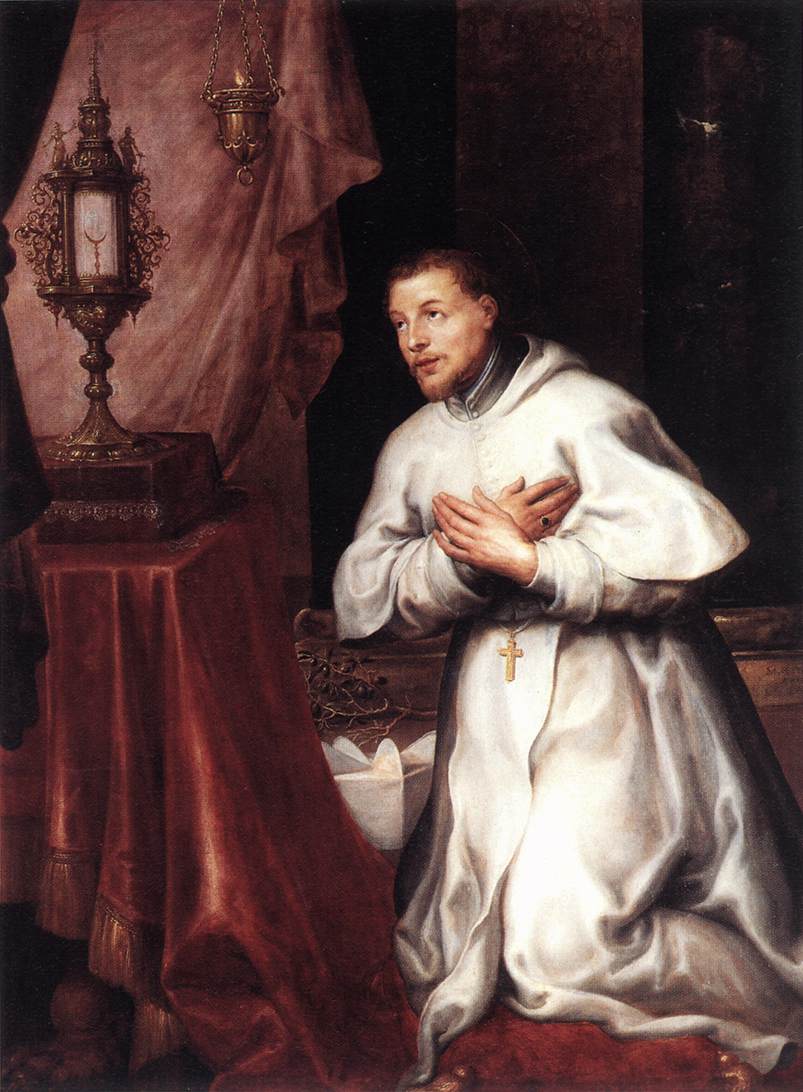
Corpus Christi is a good opportunity to think on the central mystery of the Mass. So beautiful, yet so difficult to believe in.

But I still go back every day. But does the deer that yearns for the running stream know the chemical composition of the water it drinks?

I always think of this week as the week of Tobit. He’s rather a sympathetic figure. Day by day we hear of his sufferings. He has a nice meal and goes to sleep outside. A bird lets fall its droppings in his eyes and he gradually goes blind. Eventually he marries off his son to Sarah who has lost seven husbands, died on their wedding night.

Have I got that right? It doesn’t matter. The story is about perseverance and victory in it.

Trinity Sunday to Corpus Christi

Today was Trinity Sunday, an opportunity for much intellectual religious positing on the nature of three-in-one. Perhaps we should be content with thought of God, not a lovely old man but a loving combination.

The Trinity can be a suitable excuse for a very boring theological disputation. And what has always particularly irritated me about it is the way that priests particularly state it to be true. How do they know? Faith, of course, authority. But for something as mathematical as this, how can faith be enough?

As I was thinking this, the concept seemed to chime in with my own doubts about our absolute individuality, as I lay awake I musing on this feeling that we are other people, were other people when younger, will be when older. And is not the Trinity a similar feeling? That God cannot be an absolute singleness.

This led me on Tuesday to wonder on whether a many-sidedness didn’t actually make survival after death of a single body more believable. A river does not die and nor do we.

I was in Eton College Lower Chapel for the first time on Wednesday. The chaplain reminded us that all this of which he was so proud would eventually fall into dust and only love would remain, for God is love and love not being a corporeal or even a spiritual being cannot have a beginning or an end. It is eternal.

At Mass on Thursday I had one of those moments during a reading that something gives one an immediate sense of confidence. It passes for a moment and then is gone but for the moment one has the confidence to speak one’s truth.

On Friday and Saturday I ran along the lane to our little medieval Anglican church in Lincolnshire. I decided to read through the Psalms, a new different one for every day. I was doing this, starting with Psalm 1 which I suppose is a hymn of the godly to Psalm 2 which is a denial of evil. You have to read through them in the King James Prayer Book for them to be anymore than arresting poetry but the truth sinks in or floats to the top.

Feast of the Venerable Bede

We were at the Leavers’ Mass at Stonyhurst. The sermon was remarkable but we were asked to remember just three things: have gratitude for what you’ve got, have imagination, retain hope. This seems not bad advice.

Later I was lying in bed. Every time I thought about politics, I felt depressed. Every time I concentrated on some religious theme I felt content. And later still, in the bright Sunday sunshine of a terrace, I started reading a Sunday newspaper, feeling angry as it was designed to do.

I started reading on my blackberry something about St Philip Neri. It was his feast day 26 May. He is one of my favourite saints because of his sense of fun. He refused to take things too seriously. He told one of the more pompous people who came to him for confession “As your penance, carry a cat around Rome.”

We do take ourselves too seriously.

Tongues of flame and babbling tongues

I have always had difficulties with tongues of flame and babbling tongues in many languages. But so be it, let’s assume for a moment.

On Wednesday I went with a friend to the Shrine of Our Lady of Aylesford in Kent. The Virgin appeared to St Simon Stock in the fourteenth century. She gave him the Scapular of the Carmelites. There is a lovely rosary way, the words gently seeped in. We came to a corner of the garden.

There was the third station of the Glorious Mysteries
The coming of the Holy Ghost on the Apostles
Behind the little shrine in enamel of tongues of flame
The Medway flowed gently past
brown and relentless
great trees in new green clad bending down
the M20 a murmur beyond it, of life rushing by relentless
It all fell into place
We moved on
The moment lost
the very river hidden in its trees found and lost
yet the memory of a momentary flame of belief remains, treasured.

From Ascension to Pentecost

A period of waiting. The disciples walk down the mountain. On 14 May is the feast of St Matthias Apostle. Interesting because he was chosen by lot after the betrayal of Judas. Perhaps we are all chosen by lot.

I had a dream last night that I was walking down a mountain. I don’t know what the significance of the mountain was. But the strange thing was that rather than just walking down in the open air every part of the descent was a different room with different exhibitions of life and history in them.

But neither the rooms nor the mountain had an end. Or perhaps I woke before I got to the bottom of the mountain. Or perhaps the point of all this was revealed in the dream but I have forgotten.

The Ascension

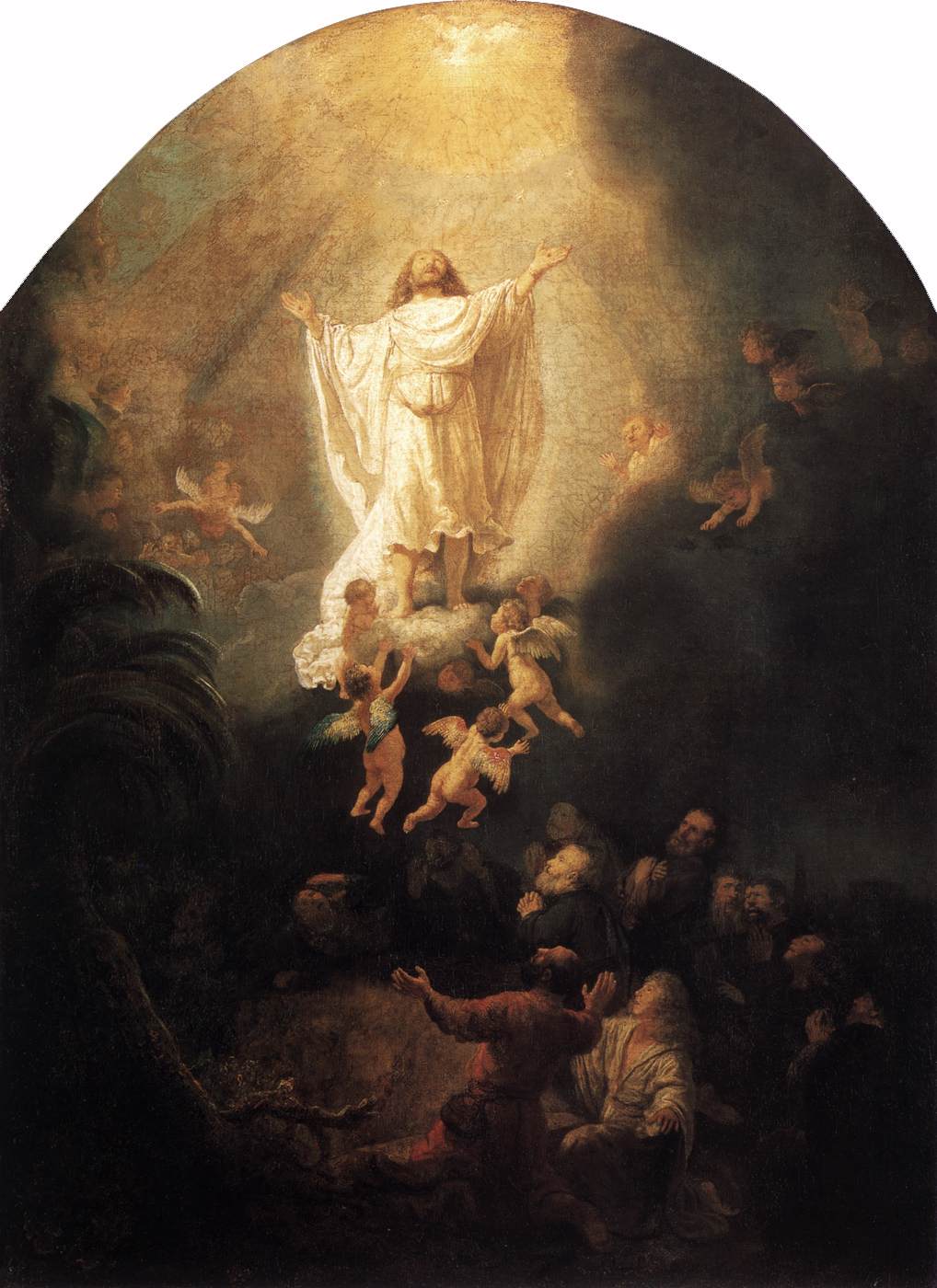
I have always been sceptical of Christ rising like a rocket into Heaven. It offends my rational mind. But this time I concentrated on the reading from the Acts of the Apostles.

“As he said this he was lifted up while they looked on, and a cloud took him from their sight.” (Acts 1:1-11)

What more natural?

Song of Bernadette

I picked up by chance “The Song of Bernadette” by Franz Werfel. It is our extraordinarily intelligent book, written by a Jewish writer who took refuge in Lourdes in June 1940. It encapsulates and analyses the central dilemma of these writings and my feelings.

I have for ten days been reading a little every day and these ten days can be covered by the question posed by this book.

A fourteen-year-old girl, asthmatic, uneducated, impoverished with a vivid imagination says she sees a beautiful “lady” in a niche of a grotto where people dump rubbish. Nobody else sees the “lady”. The Lady speaks in dialect. She calls for “penitence”, for a chapel to be built and for people to come in procession. Eventually, when asked, she says she is “The Immaculate Conception”.

Surely the best course of action in life is to call for the obvious rational explanation.

What is more likely: that a pubescent girl is deluded or that the Virgin Mary if she still exists, hangs around for two thousand years then stands on a well with a rose on her bare feet and carrying a rosary.

The poet Lafite in the book, and many others, the imperial prosecutor, prefect, chief of police, even at first the priest of Lourdes, Fr Peyramale, have no doubts.

But.

The ecstasy is undoubtedly genuine. The Lady asks her to “go eat of the plants which you will find yonder”.

ANNAT MINGUIA AGUERO HIERBO QUE TROUBERET AQUIOU

And she says “Go to the spring yonder and wash yourself.”

ANNAT HEOUE EN A HOUN B’Y-LAOUA

The stream appears. First the boy Bouhouherts, on the point of death, then many others are cured.

Bernadette, despite numerous questionings, is obviously sincere. She leads a perfect life, full of humility. She dies at the age of 35 of an incurable disease.

I have been myself to Lourdes many times, like the poet Lafite I approach the grotto.

“The rhythmic murmur became a beneficent rustling. It was like a soft support against which one could lean one’s back. And with it came the feeling as though one were surrounded by a helpfulness, encircled taken into its core. The prayers of men took Hyacinthe de Lafite into their midst. Something like smiling irony came over him. Proud and without love? Yes! But am I really so deserted, so much more than others? Would it not suffice, seeing the vast incertitude of knowledge to be no vainer than these here? What’s the difference between myself and them?”

The Afternoon Shadow

I sat and for a moment freed my thought
And looked upon the fireplace
The bright spring sun moved upon it
Yes in that great country cottage quiet
I could see my concentration so fixed
That sun and shadow do move
Yet a movement so slow
That it is both moving and unmoving
Fixed yet progressing
Determined, inflexible in the spinning earth
And every piece of browned rough cut wood
Every speck of ash
now light and dark
and now upon the yellow
wall the window frame
still yet in deep concentration moving.

The Shire

Another scene
This time a sun cloud dappled shire scene
I lay upon the gentle wold
The new cropped spring grass sweet upon my cheek
And below him every brown and green and measly yellow
In gentle lay upon my gaze
And was rounded, curved, mellowed
A distant church, the smudge of green woodland
A gentle breeze

The Trig Point

I climbed wearily up the fell.
The rain in a heavy sheet,
soaked every fibre of my trousers.
I was, it seemed, lost.
The rocks were heavy beneath my feet.
The cracks deep in water
and there finally in the cloud
the Trig Point: the highest point
From here one can see fifty miles
Today I could not see fifty feet
I sat beside its thin girth
And then some lesser dark, some
filmy grey opened above me.
I thought a helicopter in an instant
could take me above this cloud
And then a great glorious blue expanse would open before me
And then the great horizontal sleeting wind rain
Seemed to take my soul also above this rain
Climbing slowly, wearily up those rocks.
I had wondered again whom am I
Could this thought this conscience fleet itself from these tired feet?
And now high upon the fell
I hoped my soul might flee
And leave this body slumped upon the Trig stone.
I got up and walked
And then by some vent in cloud and rain
The mist was drawn aside like a curtain
And distant fields and world and walls revealed
And then was hidden once more
And I walked again down
into pale sunshine and the land of men.

Shake the dust from your feet!

“So they shook the dust from their feet in defiance and went off to Iconium.” (Acts 13:44-52)

The apostles were shaking the dust from their feet. Perhaps I should shake the dust from the feet of my unbelief and perhaps you should too.

Via Veritas Vita

The words of today’s Gospel from John which we heard at Mrs Thatcher’s funeral are some of the best-known and greatest in literature.

“I am the way, the truth, and the life.”

These sort of words are like great seas crashing on the rocks in my mind of scepticism and unbelief. The rock enduring, grey, grim points despite the magnificence of these words and their power and allure. They rise up, white, spray flying. Glorious, but the rock remains.

Feast of St Mark the Evangelist

A twelve-hour drive on my own back from Strasbourg. Before that, a last mass in the Cathedral was a bit of a relief.

The reading from Mark is a ringing final exhortation.

“Go out to the whole world, proclaim the good news to all creation.” (Mark 16:15-20)

Speaking for the Persecuted

We were to have driven back for a funeral but the car is en panne so I spoke on the persecution of Christians in the Middle East.

What can one say in three minutes? The week before I saw for myself the suffering of the Palestinian people. Christians are now down to 10% of the population of Palestine.

And here this week we are hearing the Acts of the Apostles.

“The Word of God continued to spread and to gain followers. Barnabas and Sault completed their task and came back from Jerusalem bringing John and Mark with them.” (Acts 12:24-13:5)

Morning Mass

In Strasbourg I go to the 7:30 Mass in a small chapel at the back of the Cathedral. Although it is only a ‘low’ daily mass, the priests there sing it with great reverence. It is a fine mass and worth getting up for.

I was asking a question of the Prime Minister of Georgia. We have just witnessed the peaceful handover of power in an ex-Soviet bloc country. But things, particularly with the judiciary, are already slipping.

They know His voice

“When he has brought out his flock, he goes ahead of them, and the sheep follow because they know his voice.” (John 10:1-10)

But how much time do we spend in even trying to hear that voice?

Good Shepherd Sunday

Knowing I had to spend all of Sunday driving to Strasbourg, I went to Mass on Saturday in the quiet Wolds village of Hainton.

After the ten-hour drive, I arrived at the evening Mass in the mighty cathedral of Strasbourg, the nave soaring up a hundred feet but the message was the same.

In biblical times, the shepherd led from the front. I thought of the boy shepherds I had seen the week before in the high rocky pastures of Jordan, leading a few scraggly sheep.

“I tell you most solemnly, I am the gate of the sheepfold.” (John 10:1-10)

Saturday, Third Week of Easter

I woke up in the middle of the night. I know now that, instead of fretting about decisions and difficulties, the thing is to start saying the Rosary.

But I now focussed each part of the Sorrowful Mysteries on someone I had met today in my surgery and their difficulties. However irritating, I soon fell asleep!

Today, Jesus’ followers fall away.

“After hearing this doctrine, many of the followers of Jesus said ‘This is intolerable language’.” (John 6:60-69)

The Sorrowful Mysteries

I woke up in the night and started to say the Rosary, focussing on the Sorrowful Mysteries. But now I had been there myself in Jerusalem this week.

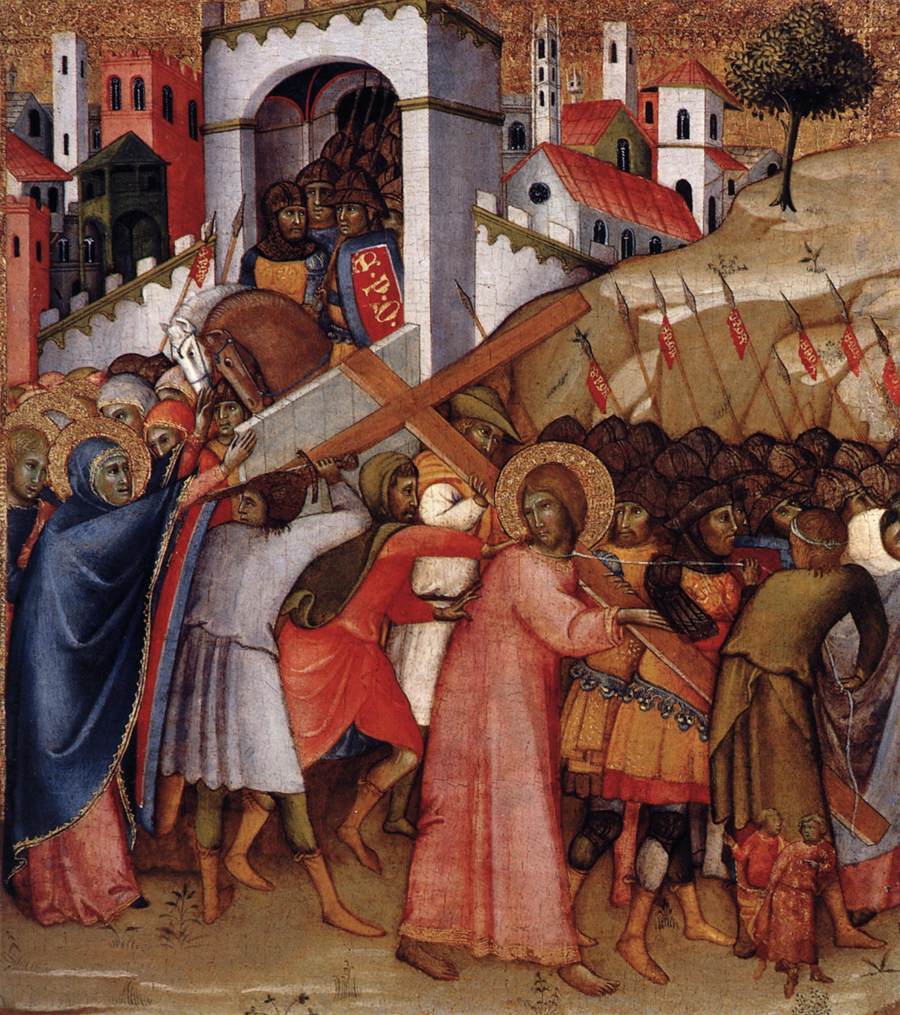
At the Trial, I was by the Lion’s Gate next to the site of Pilate’s Antonia. Continuing up the road I was by the Church of the Flagellation, where I was robbed of my 100 euros by the Austrian Hostel. At the start of the Via Dolorosa I was by the Crowning of Thorns. Up the Via I was dragging my suitcase, and at the Church of the Holy Sepulchre I was witnessing the Crucifixion.

Jesus preaches today the Eucharist: “Anyone who does eat my flesh and drink my blood has eternal life.” (John 6:52-59)

A Moment of Acceptance

The readings today are watery. Philip baptises the Ethiopian, travelling from Jerusalem on his chariot.

I was sitting there at Mass waiting for the Eucharistic prayer to end.

I suddenly had this moment of acceptance. It is not wrong to want to achieve things, run things. It is a worthy ambition, just get on with it. Some things may happen, others not. Some few successes, other times not. Others will have far greater successes, accept it.

“No one can come to me unless he is drawn by the Father who sent me.” (John 6:44-51)

Mrs T’s Funeral

Today was the funeral of Mrs Thatcher. I went.

I was very struck by the address by the Bishop of London. Stripping away all the mythology, being an “-ism”. She is now atomised, she is now one of us.

It’s all so obvious, so true, yet we forget it all the time. We all have to go where she is and power, position, wealth mean nothing there.

“Now the will of him who sent me is that I should lose nothing of all he has given me And that I should raise it up on the last day.” (John 6:35-40)