Easby Cross

We had put out a statement about marriage and civil partnerships and are awaiting a flurry of emails. I don’t often speak up, but felt compelled to do so on this occasion.

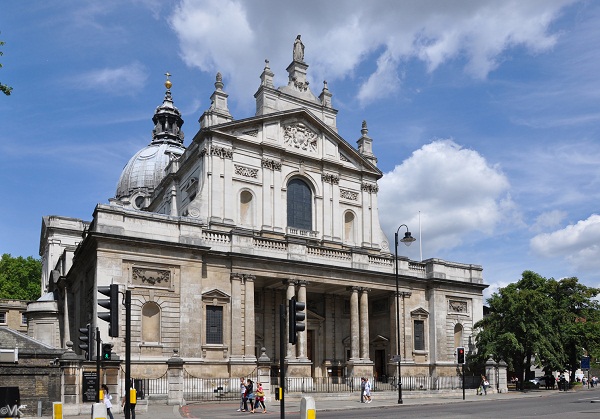
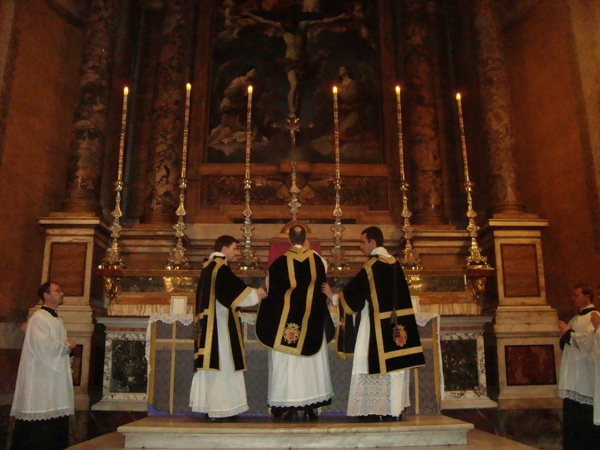
But for me, the highlight of the day was Benediction in the Little Oratory – my son’s school.

After, I made a quick visit to the V&A. Where better to idle by twenty minutes?

There, I found the Easby Cross.

It dates from around 800AD. The monumental freestanding cross was unique to the British Isles and an extraordinary feat of engineering for that time. This specimen in the V&A is one of the finest surviving. Here I saw patterns from the British isles and pictures of the Apostles, carved with the majesty of European artistry.

In the Gallary of the V&A, I was suddenly back in Celtic mists on a highland moor setting up a symbol of faith against the Pagan darkness of Tribal Northern Europe.

Water

Today, I am still thinking about water.

There was a long reading from Genesis about Noah’s watery experiences (Genesis 8-6-13, 20 – 22), and talks of a dove being released and returning to the Ark with ‘a new Olive branch at its beak.’

It set me thinking of our own flying about on the sea of life. I pondered once again.

‘In death you can only know God.’

After death, you know only God

We went to my friend Martin’s funeral.

During the short, lovely service his chaplain talked of his life and struggles.

A reading was given from St. Paul to the Corinthians, Chapter 13.

Love is patient,
love is kind and is not jealous;
love does not brag and is not arrogant,
does not act unbecomingly;
it does not seek its own,
is not provoked, does not take into account a wrong suffered,
does not rejoice in unrighteousness, but rejoices with the truth;
bears all things, believes all things, hopes all things, endures all things.
Love never fails.

In a nice gesture, his family told us to take home one of his gifted naïve paintings, namely of Tintin on a Donkey in an Oriental Court, and we did.

I walked slowly back to Hammersmith Station from Mortlake along the towpath where I had so often walked with my dog, Freddie, when I lived there as a boy. Looking at the soft, grey Thames water in the twilight, I saw the rowers from Latymer boathouse glide by, the ripples from their oars fading as ther expanded out. I thout of Martin’s soul fading from earth, too.

Where is he now?

Marriage

The government is proposing to abolish the distinction between Civil Partnerships and Marriage. Being a spiritual, rather than a political diary, this blog is not the place to go into all the arguments about that. However, I have been thinking a lot about marriage this week. In my view it is the most humanising and fruitful of all our imperfect human structures of relationship. Enough said.

The thought from the night before returned:

In death you can only know God.

So, you can know nothing else, because after death there is only God, or nothing – a void, as after consciousness of every and anything. I found this phrase enourmously satisfying, because it cannot be denied by believer or atheist.

It is why we need not fear death. It is utter annihilation or utter bliss in the presence of God. There is only life – nothing in between.

Life, then, is endlessly grey and doubting. Death either black or dazzlingly radiant.

Broken Plates

There was some row at home, which started because I clumsily broke a plate.

Resentment set in and I only made up after a few decades of the rosary on my way to the Abbey.

Perhaps this was destined to be the week of thinking about marriage. Indeed, today’s gospel from Matthew 5:17-37 comes down firmly in favour of marriage and against divorce.

Later, half asleep, a thought came to me.

‘After death you can only know God’

Between waking and sleeping it came and went, lost and found – as is the way of dreams.

But the next morning, it was still in my mind.

Dreaming Again

Gabriel was dreaming again. Mind was abandoned by body, who had passed away. Mind was aware then that he was not alone. All about him, on the stone bench were countless other minds. And mind asked: ‘Shall I become again the soul of another body?’

No. His path now is straight to God who, like mind, is pure consciousness.

He is there, and mind is within and without him.

Descartes

I have been struggling all week with Rene Descartes’ problems of dislocation between mind and body (lazily, because I didn’t read literature on the subject).

It is very interesting, but I wouldn’t go as far as the Descartes follower Nicholas Mace Branche, who argued that it is God who made interaction between mental and physical happen.

Nor do I accept Gilbert Ryle’s 1999 ‘The Concept of the Ghost,’ which, as far as I understand, claims that Discantes is fundamentally mistaken.

To Ryle, it is absurd that the mind is like a ghost in the machine – that something immaterial can pull the levers of the material.

Perhaps my response is unduly simplistic – but I think both are right.

The mind has physical properties (chemical and electrical impulses that raise my arm to drink my cup of tea), but the projection of myself, Cogito, ergo sum (I think therefore I am), is a different, unmechanical process.

Scholastica and Benedict

In the Divine Office, there is a lovely story about St. Scholastica, the sister of St. Benedict.

He used to visit her every year. At the end of his last visit, when he got up to go, she begged him to stay. When Benedict refused, she prayed so hard that a deluge of rain arrived and he had to stay. They talked all night of spiritual things.

Three days later she was dead and he sensed from afar that her soul had left her body like a dove taking flight.

The power of her prayer had given them back those precious extra hours together.

Today’s reading (Luke 10:38-42), shows a parallel to the story.

As Jesus and his disciples were on their way, he came to a village where a woman named Martha opened her home to him. She had a sister called Mary, who sat at the Lord’s feet listening to what he said. But Martha was distracted by all the preparations that had to be made. She came to him and asked, “Lord, don’t you care that my sister has left me to do the work by myself? Tell her to help me!”

“Martha, Martha,” the Lord answered, “you are worried and upset about many things, but few things are needed—or indeed only one. Mary has chosen what is better, and it will not be taken away from her.”

An Austrian coin commemorating Sts. Benedict & Scholastica

The Big Society

I went to a seminar organised by the Archbishop of Westminster on the Big Society.

Having not spent years in a seminary learning philosophy and theology, much of the discussion went over my head. Neo-Aristotelian thought is not my strong point, but I do believe in a free society.

Under the spreading branches of the vast, regulatory state that we live in, everything else starts to wither.

Even in the last thirty years, the march of the audit state has continued apace.

Professionals can do nothing without being checked and double checked.

So I do believe in letting head teachers run their schools, their admissions, staff recuruitment and curriculum as they wish.

I also believe that the all-doing regulatory state saps moisture from self help organisations and religious groups.

The soul and the spirit of the people is dried up, too.

In the garden of our Catholic Church was a tree which are children used to enjoy climbing on.

It has been chopped down.

‘Why?’ I asked.

Because it was sucking moisture from the ground that was needed by the allotment users.

The tree was beautiful and useful in itself, but in order for the small organisms state’s garden to flourish, the tomatoes and the garden beans. The tree of the state must be pruned, but sadly, pruning is often not enough.

Lectio Divina

I came across an interesting explanation of Lectio Divina; the practice of religious reading.

In reading the Gospel, we should first work out what the text is trying to say in itself, second what it is saying to us and third what we are trying to say in reply.

Today’s reading is from Mark 7 14-23.

…When he had gone back into the house, away from the crowd, his disciples questioned him about the parable, he said to them “do you not understand either?” Can you not see that whatever goes into a person from the outside outside cannot make them unclean?

I often think I can see what a text is trying to say in itself. Perhaps even what it says to me. What I find difficult is what I say in reply.

Do I just agree with the statement: “It is what comes out of a man that makes him unclean?”

Mind, Body, Machine

I have long been fascinated by the relationship between mind and body; that it is the consciousness of self and body. It seems that neither in Science nor in Philosophy is there any satisfactory explanation of how a physical process in the brain can create any self consciousness.

Nobody has ever been able to teach a machine to think, although at one time, this was thought to be just round the corner.

In the year I was born – 1950 – the computer mathematician Alan Turing wrote:

I believe that at the end of the twentieth Century, the use of words and general educated opinions will have altered so much that we will be able to speak of machines thinking without expecting to be contradicted.

In fact, no one has even begun to make a machine think.

Is this because thought is fundamentally non mechanical?

If thinking is unrelated to the mechanics of the body, will it not survive the death of the body? Perhaps thought is, in fact, our soul.

Pray Unceasingly

There have been three themes running through my mind in this fifth week of ordinary time.

The first in the reality of ourselves as individuals.

The second is prayer and its purpose.

The third is what can be gained from Lectio Devina.

We started our week with our priest here in Lincolnshire telling us that we were people of prayer. That the Muslims may pray five times a day but we have to pray all day. That we should pray when we see an ambulance rushing past, or any event.

I find this almost impossible. Once I leave a church, I forget about it. I wonder what the trick is.

Tying a knot in one’s handkerchief, perhaps!

Mind and Body

Gabriel had a dream. His mind somehow became separated from his body. He was in a maze, but it was a maze without limit or time. The body wandered off.

Because it no longer had a mind, it was happy. It rushed two and fro, sometimes just the other side of the hedge from mind, sometimes miles away. The mind had no body and could not move for countless ages it sat on the stone bench at the centre of the maze. Because it had no body, it never grew old. It was never hungry of thirsty, nor cold.

But in its body, it had no pleasure. Eventually, Body returned. By now, those legs which had walked so briskly were bent and frail. Its once handsome face old and ugly. And body said to mind ‘come with me again, I have seen all things, been to all continents and have felt every pleasures, whereas you lie alone, unmoving, on your stone bench.’

Because mind could not talk or move, it could only pray. Mind’s whole was just prayer with and about God, who, like mind, was formless. And mind answered with no voice.

‘Leave me, I have no past or future or present; no movement; only stillness. Dead to the world, I am content.’

Happiness

I was reading this passage which a friend saw. I can’t remember the exact words but it read something like:

The way to happiness is to do the Lords will.

I said to my friend, “All very well, but how do you know the Lord’s will?”

His faith is a lot greater than mine and to him the answer is simple: It is contained in John 13; Acknowledge that Jesus came into the world to save the world and then to follow him is to find happiness.

I wish I had such certainty.

Later today I was talking to a person about the nature of happiness. He came from Africa where many have nothing.

“Some people are happy with nothing,” he said, “some unhappy. Some people are happy with everything, some unhappy.”

Happiness has nothing to do with what we have but what we are.

But at the end of the day we can only take refuge in all of those lessons we learned in today’s Gospel.

Do not let your hearts be troubled. Trust in God, trust also in Me. In my Father’s house there are many mansions; otherwise I should have told you. I am going now to prepare a place for you.

St. Blaise & St. Theodore

There are three saints Theodore. My son’s godfather is making an icon for him with the saint he was named after and decided to put all three on it. But we celebrate the St. Theodore today who, at the ripe old age of 65, was sent over to help convert the Anglo-Saxon English and did a good job of it by all accounts.

I had been feeling ill all week. I had a cough, so I had high hopes of St. Blaise, the patron saint of throat conditions, as the candle was laid on our necks after Mass. Almost immediately after, I coughed again! But the throat feels a little better now.

I learnt Friday that a friend, Martin, who I go swimming with every day has died suddenly. One moment he was swimming. On Saturday he said he felt dizzy. On Sunday he said he was better and on Sunday night he was dead. Little older than me.

He was a night porter by trade, a man of great charm, of noble simplicity and no ambition, without an enemy in the world. Also a well-skilled painter of scenes usually from some imaginary Oriental court. To my great delight, he recently gave me one of his paintings which I shall treasure.

After swimming, I often walked with him along the side of the Serpentine. He walked very slowly, and he used to wave as I turned left. Now I will always see him walking on, into the unknown.

The divide between life and death is so brittle, a gently, wavy, threadbare curtain through which one can pass so easily and quickly.

But as I lay awake at night I was sure that I now have a friend in heaven.

Today’s Gospel is from St. Mark:

And so the Lord Jesus after he has spoken to them was taken up into Heaven.

(Mark 16:15-20)

Candlemas

After the beauties of Rome under a mild utterly blue cloudless white sky to return to the ordinary streets of grey London is a depressing thing.

But to cheer us up as we went to a hearty Candlemas for my son’s school in the Little Oratory. I love the moment after one stands outside the church as the candles are blessed. Then there comes a moment when the candles are lit.

For me the words of old Simeon are some of the most moving in the Gospel.

Now Lord you have kept your word. Let your servant depart in peace.

And the words of the Priest will end in a happy tale.

Forty days ago we celebrated the joyful birth of our Lord Jesus Christ. Today we recall the holy day on which he was presented at the Temple.

S. Luigi dei Francesi

I set off across town to find the chapel of the nuns in the Piazza Farnesi. Frequently losing my way and going up to grumpy carabinieri: “Scusi, dove e Piazza Farnese per favore?”

Eventually as I rounded the corner of the Piazza I saw the nuns locking the gate after early morning mass. No matter. I found a Mass in Santa Maria dei Maddalena in Roma. It has extraordinary soaring baroque ceilings and a beautiful Madonna della Salute.

These churches are amazing. The day before I turned a corner and went in by chance to S. Luigi dei Francesi and found the most extraordinary Caravaggio. What an amazing life, what extraordinary genius, and then to throw it all away as a hated fugitive from justice.

In a dimly lit side chapel is a plaque on which were written in French these quite nice words about a former French Ambassador to the Holy See.

“His love of the Church was only exceeded by his love of his country.”

A nice epitaph.

Santa Maria in Aquiro

If you walk out of your hotel in Rome first thing in the morning, you will find within five minutes a glorious Renaissance church of Mary. (Santa Maria in Aquiro). There were only three of us in the side chapel. Before the reading of the liturgy, we are invited to the back of the Church. I understood why because next thing the priest summons all of us forward to do the readings. Luckily I am not in the first row or I would have had to do it. I can just about read and pronounce Italian but the thought of doing it in public can terrify you.

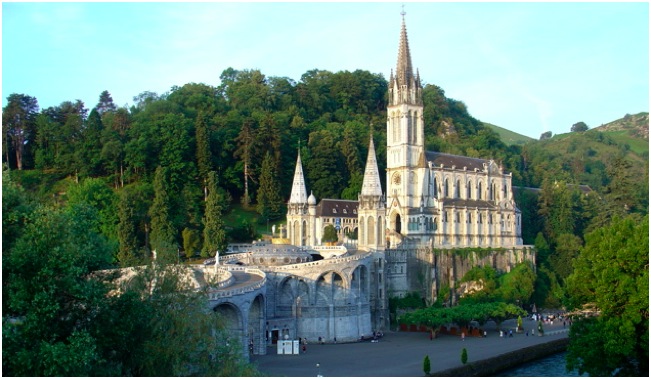
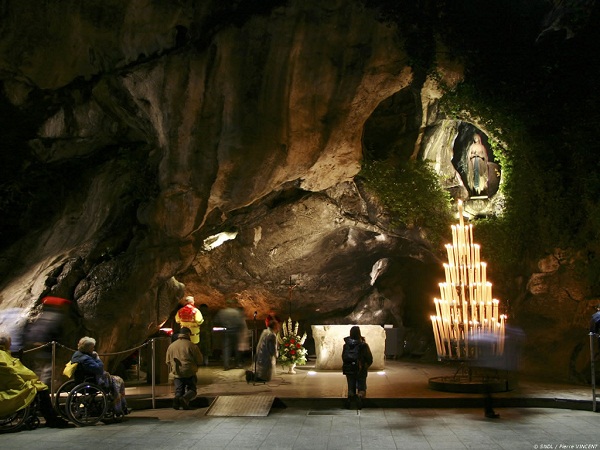
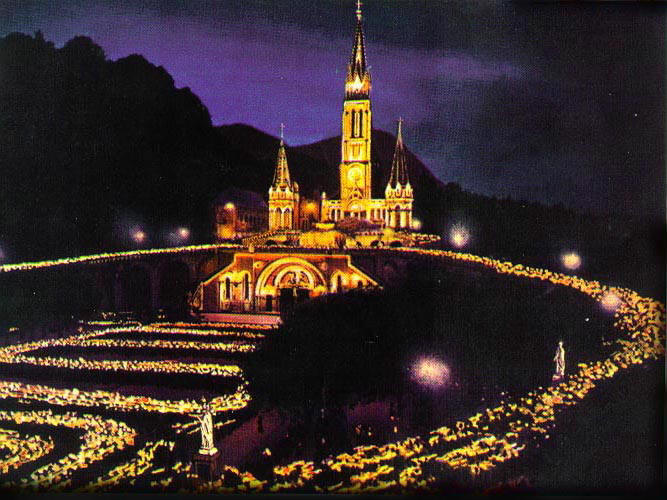
Afterwards the priest gave us a little card in honour of Santa Maria di Lourdes. “Defendi i deboli, conferma gli innocenti, converti i peccatori, risana gli infermi, consola gli affliti.”

The point of course is that St. John Bosco loved children and Mary chose to appear to a child, Bernadette.

Unless you change and become like little children you will never enter the Kingdom of Heaven.

(Matthew 18:1-5)

Therese

This is a marvellous film about St. Therese of Lisieux.

There is no music at all, just poetic insight into her way of love being found in the smallest things.

What I found most interesting about the film was its simplicity. Nothing was exaggerated or hurried. The heroism and the drama was contained in a placid acceptance and silence. Here is a concerned renunciation not of the world but of reliance on the world.

I am reminded of the words in today’s Gospel.

It is the Spirit that gives life, the flesh has nothing to offer. The words I have spoken to you are spirit and they are life.

Diary of a Country Priest

This is a film made in 1950. It starts in a pretty miserable frame of mind and it gets even more miserable. It is black and white and the French sound quickly has deteriorated yet its inextricably moving. A young country priest battles with his unpopularity, doubts, and lack of faith, and finally a dose of stomach cancer.

He ends his last days staying with a friend in one of those depressing 1950s towns which I remember as a boy, when France seemed so backwards. Now it has leapt ahead of us. But at the end of the film, the Cure as he lays dying has a blessing from his old seminarian friend who says he cannot give it he is no longer a priest. The cure replies “all is grace, all is grace”.

Today’s reading from Hebrews 10:32-39 might have been intended for him.

Only a curtain

Gabriel once more has this strange disconnect between his physical persona and his soul as if they were quite separate. That the soul could be free, that it could leave the body and be somewhere else. That there was a curtain between reality and spirituality but only a curtain, to be opened at the flick of a hand.

Through the blood of Jesus we have the right to enter the sanctuary by the new and living way which he has opened for us through the veil, that is, his body.

(Hebrews 10:25)

Feast of the Conversion of St Paul

In the Modern Art Museum of Strasbourg is a huge, at least 30-by-20 foot picture by Gustave Dore of Christ leaving the Praetorium.

It is a monumental work of art. Only Christ looks at the viewer. But it is also work of a dark and coming crucifixion, powerful in its grim intensity. Despite its darkness, light seems to leap out like the light Paul saw on the road to Damascus, sudden and determined to illuminate.

St Francis de Sales

These words seemed to come back again and again. Jesus says ‘come to me, all who labour and are heavy laden, and I will give you rest.’

In the cathedral chapel the evening before. At early morning mass in the Cathedral today. At early morning mass in the cathedral today and coming across in another church, Eglise St. Pierre.

VENEZ A MOI, VOUS TOUS QUI PEINEZ, SOUS LE POIDS DU FARDEAU
ET MOI JE VOUS PROCURAI LE REPOS

Three times in less than twenty-four hours I had come across them. They bring great joy and solace in their assurance, a helping Lord. Always on the shoulder, invisible, but more real than apparent reality.

Simplicity, Power, and Truth

In Strasbourg Cathedral there is a quiet place – The Chapelle St. Laurent. And inside are written these words:

Jesus Spricht: Kommt Zu mir alle, die ihr euch plagt, ich werde euch ruhe verschaffen.’

Jesus dit: ‘Venez à moi, vous tous qui peinez. Je prendrai votre fardeau.’

Jesus says: ‘Come to me all who labour and are heavy laden and I will give you rest.’

The three languages seem to unite the message in its simplicity, power, and truth.

Walking Up the Wold

Walking up the wold,
The scene came from all time.
And from none.
No sound, no telegraph, no house
Marred this view
Only a flock of sheep
Unchanging, wandering silently
Great valley, stretched away
High hills, all in wintry light
This scene could have been one hundred
One thousand, two thousand years ago.
A Viking raider, a Saxon serf.
A civil war crusader, a Ninteenth Century Landowner.
All could come passing down this path.
And on this hill, without time
And my mind took a sudden shift in realisation
That I am not just in this moment of time
This reality; there is another and another
Unknown, seek it and cannot place it
Present reality’s bands are too strong
And for a moment, I am back here.